

4.4.2 - How to determine them?
Qualitative and quantitative method for estimating the uncertainties of a Bilan Carbone®.

Uncertainties within a Bilan Carbone® take two different forms. The first is qualitative, that is to say characteristics are defined for activity data and emission factors, then rated qualitatively. The second is quantitative, stems from the qualitative information and leads to the determination of a 95% confidence interval.
Reporting formats
Taking uncertainties into account leads to three different but correlated forms of results:
A qualitative uncertainty on GHG emissions, ranging from "Very high" to "Very low"
A 95% confidence interval, that is an interval [Lower Bound; Upper Bound] within which the result has a 95% chance of lying
A percentage value, which means that the result is potentially
 % higher than its value:
These three forms of results are complementary and make it possible to report uncertainties to audiences with different levels of understanding of these issues.
Qualitative determination
The qualitative determination of uncertainties for an emission source involves completing two matrices, one for the emission factor and the other for the activity data. To fill in these two matrices, the organisation shall assign a quality rating (Very good, Good, Average, Poor, Very poor) to each of the five characteristics of the activity data or emission factor. The meaning of the different characteristics is detailed below.
Technical representativeness
Very good
Geographical representativeness
Good
Temporal representativeness
Average
Completeness
Poor
Reliability
Very poor
The five characteristics used are as follows:
Technical representativeness: This characteristic assesses whether the value is truly representative of the current state of techniques and technologies used. EF: Assesses whether technological advances have occurred since the creation of the emission factor. AD: Assesses whether the activity data comes from a different or obsolete technology.
Geographical representativeness: This characteristic assesses whether the value is well suited to the geographical location of the emission source. EF: Assesses whether the emission factor applies to a territory different from that of the emission source. AD: Assesses whether the activity data comes from a different territory.
Temporal representativeness: This characteristic assesses whether the value is up to date for the emission source. EF: Assesses whether the emission factor is sufficiently up to date, whether its validity period has been exceeded, or whether changes have occurred since the creation of the emission factor. AD: Assesses whether the activity data used comes from a different year than the year the assessment was carried out.
Completeness: This characteristic assesses whether the value is statistically representative of the emission source. EF: Assesses whether the emission factor is developed from a representative data set. AD: Assesses whether the activity data comes from statistical averages or extrapolations based on an insufficient number of data points.
Reliability: This characteristic determines whether the method of collecting the activity data and the source from which the emission factor originates are reliable. EF: Assesses whether the emission factor comes from an unqualified or unreliable source. AD: Assesses whether the activity data is based on a rough or even speculative estimate rather than a precise measurement.
For an emission factor:
If the emission factor (EF) comes from a database using uncertainties, the matrix shall be reproduced or completed using the information from the database.
🔎 For the Base Empreinte®, for example, users can directly reuse the ratings associated with the EF characteristics from the database. These ratings assess the EF's ability to represent what it claims to be.
However, it may be that the organisation uses an emission factor that is not entirely adapted to the emission source considered. Thus, for organisations wishing to be more precise in their treatment of uncertainties, it may be relevant to adjust and reevaluate the ratings of the different characteristics coming from databases.
Example: The emission factor for a Spanish orange comes from a very good-quality LCA, and all its ratings show "Very good". An organisation that used this emission factor for oranges from another country should ideally downgrade the rating associated with the "Geographical representativeness" characteristic.
If the emission factor does not come from a database using uncertainties, the matrix shall be established from the documentation provided on the EF. If no documentation is available, the ratings associated with the EF in the matrix shall be low.
⏳[WIP] A practical example of completeness (qualitative and quantitative) of the uncertainty will be available shortly, in the appendix.
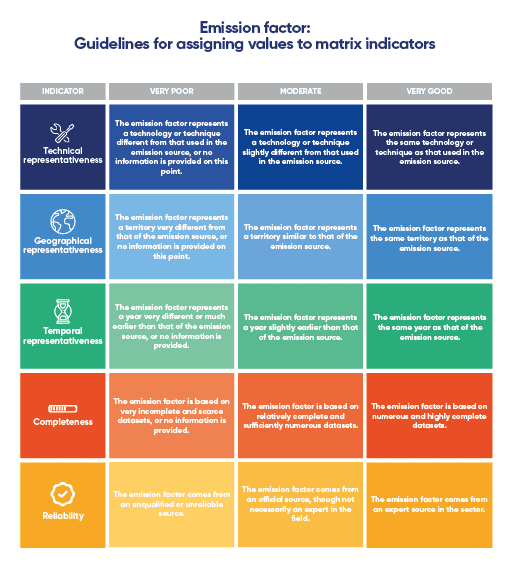
Guidance for completing the matrix for an emission factor is given below.

🌐 English version of this image.
For an activity data:
For activity data (AD), the organisation shall assign a rating to the activity data used.
Example: The organisation's data is a number of kWh taken from the twelve invoices associated with the chosen temporal boundary. The organisation assigns the rating "Very good" to this activity data.
However, for organisations wishing to be more precise in their treatment of uncertainties, it is possible, as for emission factors, to assign a rating to each of the five characteristics of the matrix.
⏳[WIP] A practical example of completeness (qualitative and quantitative) of the uncertainty will be available shortly, in the appendix.
🔎 Completed uncertainty matrices for typical collection methods will be available shortly on the General Carbon Plan.
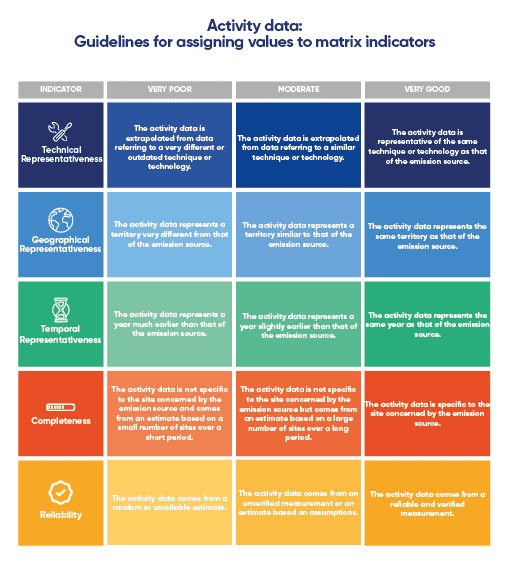
Guidance for completing the matrix for activity data is given below.

🌐 English version of this image.
Quantitative determination
The quantitative determination of uncertainties does not require any additional effort from the organisation. Bilan Carbone® tools use the qualitative determination of uncertainties to automatically arrive at this quantitative determination. For this quantitative approach, it is assumed that the distribution laws of uncertainties are log-normal.
The matrices obtained via the qualitative determination serve as the basis for the quantitative determination. Coefficients are associated with each quality for each characteristic according to the matrix below:
Technical representativeness
Very poor
Poor
Average
Good
Very good
U1 = 2.00 U1 = 1.50
U1 = 1.20
U1 = 1.10* U1 = 1.00 *Coefficient assigned by the ABC
Geographical representativeness
Very poor
Poor
Average
Good
Very good
U2 = 1.10 U2 = 1.05*
U2 = 1.02
U2 = 1.01 U2 = 1.00 *Coefficient assigned by the ABC
Temporal representativeness
Very poor
Poor
Average
Good
Very good
U3 = 1.50 U3 = 1.20
U3 = 1.10
U3 = 1.03 U3 = 1.00
Completeness
Very poor
Poor
Average
Good
Very good
U4 = 1.20 U4 = 1.10
U4 = 1.05
U4 = 1.02 U4 = 1.00
Reliability
Very poor
Poor
Average
Good
Very good
U5 = 1.50 U5 = 1.20
U5 = 1.10
U5 = 1.05 U5 = 1.00
The geometric standard deviations (GSD) associated with the activity data and the emission factor are then calculated using the following formula:

These two geometric standard deviations are then combined to obtain a standard deviation for the emission source, using the following formula:

Using this geometric standard deviation, the organisation obtains the 95% confidence interval for the emission source which is as follows:

The lower value of this interval is called the "Lower Bound", and the upper value is called the "Upper Bound". It is then possible to propagate these uncertainties associated with the different emission sources to obtain uncertainties on an emission subcategory, an emission category or on the entire assessment.
For a given emission source, its sensitivity is defined as its weight in the total assessment. Let E1 be the value of an emission source and T the total value of the assessment, the sensitivity S1 of the emission source E1 is:

Let E1 and E2 be the values of two emission sources, S1 and S2 their respective sensitivities and GSD(E1) and GSD(E2) their respective geometric standard deviations, the geometric standard deviation on E1 + E2 is:

The 95% confidence interval is then obtained using the same method as previously.
⏳[WIP] A practical example of completeness (qualitative and quantitative) of the uncertainty will be available shortly, in the appendix.
Requirements relating to uncertainties
Here are different requirements to be achieved in terms of taking uncertainties into account for each of the 3 maturity levels.
Beginner level: criterion M1
The organisation shall qualify and quantify the uncertainties for all direct emissions and significant indirect emissions of the Bilan Carbone® (as a reminder, this represents at least 80% of emissions).
The qualitative determination of uncertainty can be carried out:
by assigning a single quality rating (Very good, Good, Average, Poor, Very poor) to each activity data concerned. This overall rating is thus representative and consistent with all 5 characteristics.
by using as is the ratings of emission factors from databases.
The quantitative determination of uncertainty is automatically calculated from the qualitative determination.
Intermediate level: criterion M2
The organisation shall qualify and quantify the uncertainties for all direct emissions and significant indirect emissions of the Bilan Carbone® (as a reminder, this represents at least 80% of emissions).
The qualitative determination of uncertainty can be carried out:
by assigning a single quality rating (Very good, Good, Average, Poor, Very poor) to each activity data concerned. It is nevertheless recommended to assign a rating to each of the 5 characteristics (technical, geographical, temporal representativeness, completeness and reliability), i.e. 5 ratings for each activity data responsible for the most significant of the assessment.
by using as is the ratings of emission factors from databases. It is nevertheless recommended to adjust these ratings when the actual use is not exactly within the scope of application foreseen by the database.
The quantitative determination of uncertainty is automatically calculated from the qualitative determination.
Advanced level: criterion M3
The organisation shall qualify and quantify the uncertainties for all emissions of the Bilan Carbone®.
The organisation shall systematically use the five characteristics for activity data and modify the ratings attributed to emission factors by databases when this is relevant.
The qualitative determination of uncertainty shall systematically be carried out:
by assigning a quality rating (Very good, Good, Average, Poor, Very poor) to each of the 5 characteristics (technical, geographical, temporal representativeness, completeness and reliability), for each activity data used.
by adjusting the ratings of emission factors from databases, when necessary (when the actual use is not exactly within the scope of application foreseen by the database).
The quantitative determination of uncertainty is automatically calculated from the qualitative determination.
All information on the operational boundary is documented and Do you have a comprehension question?Consult the FAQ . The method is living and therefore likely to evolve (clarifications, additions): find the.
Last updated