

1.2 - Define the steering of the Bilan Carbone® approach
What steering and governance shall the organisation put in place?
The organisation shall establish internal steering and governance enabling the completion of the approach and the achievement of the criteria associated. The organisation shall ensure that contributors have the necessary methodological skills and are trained in the use of the tools employed, as well as in the development and implementation of transition plans.
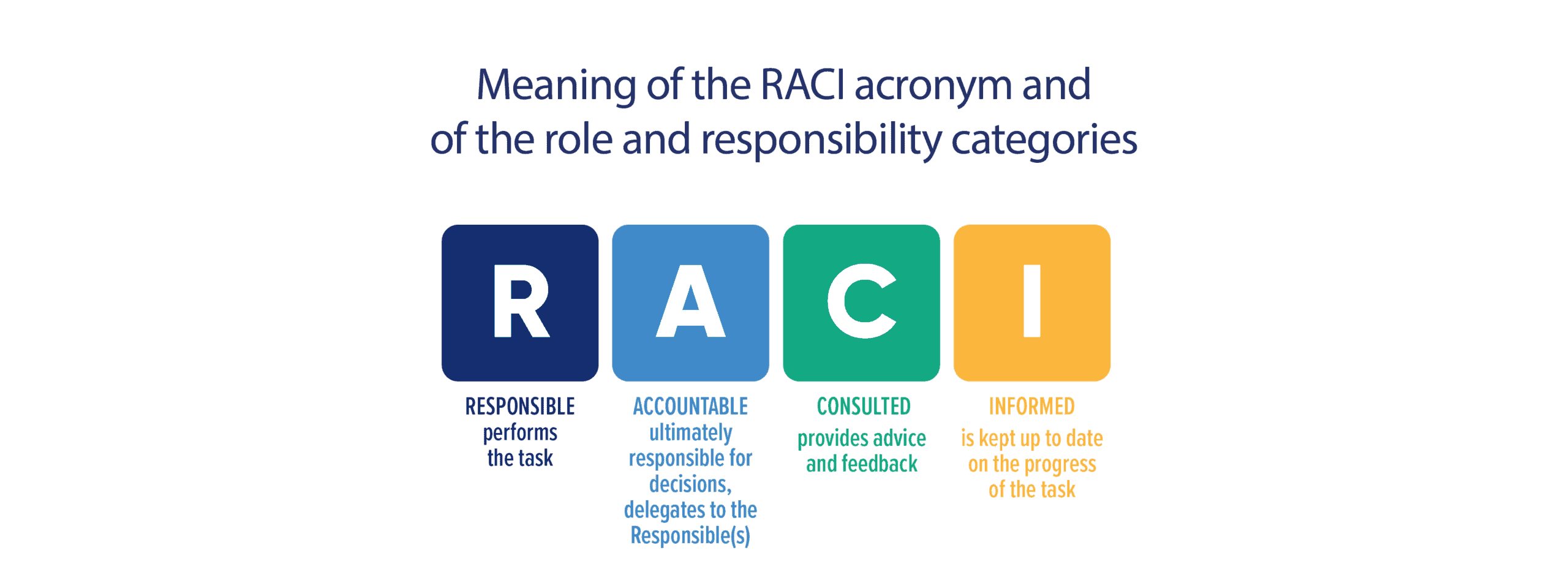
🔎 The organisation may use the RACI to structure and clarify the roles and responsibilities of the different stakeholders of the approach.

🌐 English version of this image.
Requirements relating to the pilotage of the Bilan Carbone®
Here are the different requirements and recommendations, for each of the maturity levels, which meet increasingly ambitious steering conditions.
Beginner level: criteria A1, B1, C1 and D1
Management
Management shall request or at least be informed of the carrying out of the Bilan Carbone®. It informs its employees about the launch of the approach and their potential participation.
Coordination
For carrying out a Beginner level Bilan Carbone®, a coordinator is appointed internally. They steer the approach and coordinate the operational execution of the Bilan Carbone®, for which two options are possible:
The approach is carried out internally; the coordinator acts alone or with internal operational officers brought together in a project team. These operational officers are trained in the Bilan Carbone® method. They use the ABC tools (Bilan Carbone® software or spreadsheet), or, failing that, a tool compliant with the Bilan Carbone® method.
The approach is accompanied by a specialised consultancy firm, the operational officers are consultants trained in the Bilan Carbone® method. They support the execution of the approach, in whole or for certain key phases. They use the ABC tools (Bilan Carbone® software or spreadsheet), or, failing that, a tool compliant with the Bilan Carbone® method.
This choice may vary depending on the organisation's ambition: a one-off project will more easily be carried by a provider while a long-term approach should be carried internally.
For information, the introductions to each of the 7 steps of the method can provide indications on the sizing of the time to be allocated.
Transition Plan
The transition plan of an organisation with Beginner level maturity is the responsibility of the coordinator of the Bilan Carbone®, as well as of the project officers. They take charge of:
its development. It will require a Stakeholder engagement phase.
the implementation of the actions composing it (in collaboration with the action owners identified for each action).
its monitoring throughout its implementation.
Implementation, as well as monitoring of the transition plan, shall be carried out internally within the organisation.
Documentation
The organisation shall establish and maintain documentation concerning its carbon accounting. This documentation shall in particular detail:
The deliverables obtained at each stage of the approach, which are the subject of an internal results presentation.
The names of the employees who participated in these exercises and the training they have undergone
This documentation shall be used when renewing the Bilan Carbone® and for a potential evaluation.
Renewal
The organisation shall anticipate the renewal of the approach, which is carried out at least every 4 years for a Beginner level Bilan Carbone®.
The organisation shall improve the steering of the Bilan Carbone® approach from one cycle to the next in order to progressively reach higher maturity levels.
🔎 If the Bilan Carbone® is used for reporting BEGES-R, this periodicity coincides with that of the regulation for private law organisations. A point of vigilance for public law organisations for whom the renewal period is 3 years.
Intermediate level: criteria A2, B2, C2 and D2
Management
Management shall request the carrying out of the Bilan Carbone®. It informs its employees about the launch of the approach and their potential participation.
At least part of the organisation's management shall be engaged. The results of the approach are reported to management, which participates in the development of the transition plan.
Coordination
The coordinator shall be trained. in the Bilan Carbone® method. They must, by choice, have already carried out the previous Bilan Carbone® or have benefited from the transfer of knowledge from the previous assessment.
A project team made up of operational officers trained in the Bilan Carbone® method shall be formed around the coordinator. A specialised consultancy firm, trained in the Bilan Carbone® method, may be solicited for certain parts of the approach, notably for the accounting. They use the ABC tools (Bilan Carbone® software or spreadsheet), or, failing that, a tool compliant with the Bilan Carbone® method.
For information, the introductions to each of the 7 steps of the method can provide indications on the sizing of the time to be allocated.
Transition Plan
The transition plan of an organisation with Intermediate level maturity depends on different people:
its development is the responsibility of the coordinator of the Bilan Carbone®, as well as of the project officers. A Stakeholder engagement phase will be necessary, with the main operational functions that will be concerned by the implementation of the transition plan (such as the procurement department, production, the finance department, the management, among others). They must participate in its development so that it is adapted to the organisation's activity and to those who will implement it.
the implementation of the actions composing it is the responsibility of the coordinator of the Bilan Carbone®, or of the project officers, but the operations to be carried out are delegated to the services concerned.
its monitoring throughout its implementation is the responsibility of the coordinator of the Bilan Carbone®, or of the project officers. The results of the approach are reported periodically to management.
The implementation, as well as the monitoring of the transition plan, shall be carried out internally within the organisation.
Documentation
The organisation shall establish and maintain documentation concerning its carbon accounting. This documentation shall in particular detail:
The deliverables obtained at each stage of the approach, which are the subject of an internal results presentation.
The names of the employees who participated in these exercises and the training they have undergone
This documentation shall be used when renewing the Bilan Carbone® and for a potential evaluation.
Renewal
The organisation shall anticipate the renewal of the approach, which is carried out at least every 4 years for an Intermediate level Bilan Carbone®. It is expected between each renewal of the complete Bilan Carbone® to monitor the indicators in a monitoring system (the most significant emissions and actions implemented in the transition plan).
🔎 If the Bilan Carbone® is used for reporting BEGES-R, this periodicity coincides with that of the regulation for private law organisations. A point of vigilance for public law organisations for whom the renewal period is 3 years.
Advanced level: criteria A3, B3, C3 and D3
Management
At least one member of management shall be the project lead for the Bilan Carbone® approach. They are responsible for integrating the approach into the organisation's overall strategy. They are guarantor of the application of the transition plan within the organisation. They must undertake the training Bilan Carbone® for Decision Makers.
Coordination
The coordinator shall be trained in the Bilan Carbone® method. They must, by choice, have already carried out the previous Bilan Carbone® or have benefited from the transfer of knowledge from the previous assessment. The entire Bilan Carbone® approach is internalised and steered by the coordinator.
A project team made up of operational officers trained in the Bilan Carbone® method shall be formed around the coordinator. They use the ABC tools (Bilan Carbone® software or spreadsheet), or, failing that, a tool compliant with the Bilan Carbone® method. Consultants may be solicited to consolidate the approach (specify the accounting by LCAs, provide strategic advice, provide pedagogical awareness, etc.).
For information, the introductions to each of the 7 steps of the method can provide indications on the sizing of the time to be allocated.
Transition Plan
The transition plan of an organisation with Advanced level maturity depends on different people:
its development is the responsibility of the coordinator of the Bilan Carbone®, as well as of the project officers. A Stakeholder engagement phase will be necessary, with the organisation's management, the main operational functions that will be concerned by the implementation of the transition plan (such as the procurement department, production, the finance department, the management, among others...), as well as certain external stakeholders (such as some suppliers having a key impact on the value chain). These stakeholders participate in its development so that it is adapted to the organisation's activity and to those who will implement it.
the implementation of the actions and the monitoring of the transition plan are the responsibility of the internal operational functions concerned. For this, internal referents, at least one per operational function, are determined. These members have all completed the training Bilan Carbone® for Decision Makers, and hold responsibilities within the organisation. The results of the approach are reported periodically to management and at least one member of management is guarantor of the application of the transition plan within the organisation.
Implementation, as well as monitoring of the transition plan, shall be carried out internally within the organisation.
Documentation
The organisation shall establish and maintain documentation concerning its carbon accounting. This documentation shall in particular detail:
The deliverables obtained at each stage of the approach, which are the subject of an internal results presentation.
The objectives and the boundaries of said accounting
This documentation shall be available and communicated within the organisation and to its possible partners. This document is used for a potential evaluation.
Renewal
The organisation's complete Bilan Carbone® is renewed at least annually, but the most significant emission categories and the actions undertaken in the transition plan can be monitored more regularly, whether monthly or semi-annually. A monitoring system facilitating the carrying out of the assessment, and the continuous monitoring of indicators related to the transition plan shall exist, enabling the feeding and steering of the organisation's overall strategy.
Collective approach:
It is possible to carry out the Bilan Carbone® approach collectively, by partnering with several other organisations each wishing to carry out a Bilan Carbone®.
It is advisable to associate organisations of a similar maturity level.
These collective operations are particularly useful for organisations belonging to the same sector of activity or the same geographical area. They allow organisations to exchange good practices, help each other, remain engaged or pool resources.
Deliverables relating to the scoping of the approach
The information and deliverables obtained at the end ofstep 1, and associated with the above requirements, shall be reported at the end of the approach:
Do you have a question about understanding? Consult the FAQ. The method is living and therefore likely to evolve (clarifications, additions): find the change log here.
Last updated