

1.1 - Define your Bilan Carbone® maturity level
What is the organisation's current and desired maturity regarding the Bilan Carbone® approach?
To determine the maturity level of its organisation in terms of carbon accounting and its positioning on the low-carbon transition pathway :
Is the organisation carrying out its first or nth Bilan Carbone®?
What are the internal and external expectations?
What resources are available?
Will this be a first or yet another awareness-raising on planetary issues?
There is a gradient of maturity degrees, from the beginner organisation to the most experienced. To adapt to this diversity, the Bilan Carbone® method is divided into 3 major maturity levels (Beginner, Intermediate and Advanced), which are presented here.
It is strongly recommended to read the contents of the higher maturity levels, even if they do not immediately concern your organisation a priori, because, in a logic of continuous improvement and progression, certain specific points from the higher levels may already be sought and achieved.

🌐 English version of this image.

Beginner level: A first Bilan Carbone®
The organisation's objective is to Stakeholder engagement certain key teams to carry out a first accounting of its GHG emissions, and to establish a simple transition plan associated with short-term objectives. One objective of this first transition plan will be to renew the approach aiming for a Bilan Carbone® of Intermediate level.
Hierarchical involvement and governance on the carbon topic are emerging.
In general, this level is suitable for a beginner organisation or a small structure with few resources, carrying out its first Bilan Carbone®, wishing to respond to the Regulatory GHG Assessment, or to the Diag Décarbon'action.
⏳[WIP] Testimonials: feedback from a Beginner Bilan Carbone® will be available here soon.
Intermediate level: A Bilan Carbone® with actions targeting all emissions
The objective of a Bilan Carbone® approach at Intermediate level is to carry out an exhaustive accounting of its emissions, in order to establish a complete, quantified transition plan, including medium-term objectives. All Stakeholders will be Stakeholder engagement, whether internal or external to the organisation.
Hierarchical involvement and governance on the carbon topic are increasingly integrated.
This is the Bilan Carbone® as it has been historically carried out, and concerns the majority of organisations. A Bilan Carbone® of Intermediate level is typically an improved renewal of a previous Beginner level approach.
⏳[WIP] Testimonials: feedback from an Intermediate Bilan Carbone® will be available here soon.
Advanced level: A Bilan Carbone® that steers a true transition strategy
An Advanced level Bilan Carbone® is characterised by an in-depth accounting of the most significant emission categories.
The organisation has equipped itself between two renewals of the Bilan Carbone® (or equips itself during the approach) with an analysis of transition risks and opportunities in addition to its Bilan Carbone® approach.
The organisation has equipped itself between two renewals of the Bilan Carbone® (or equips itself during the approach) with a genuine low-carbon transition strategy (possibly via ACT Step-by-Step or other equivalent methods). The organisation can amend it, and monitor its evolution thanks to the regular renewal of the Advanced level Bilan Carbone®.
The Bilan Carbone® serves as an internal steering and management tool for the organisation's GHG emissions. Carbon indicators feed into the organisation's overall strategy. It is relevant for an Advanced level to set up a analytical carbon accounting to obtain reading keys by area of responsibility, and allowing the Bilan Carbone® of the organisation to be installed as a decision-making tool.
The transition plan is quantified, and sets a long-term emissions reduction objective, or even a business model transformation, validated by a decarbonisation trajectory scheduled for the short, medium and long term. All Stakeholders are Stakeholder engagement.
The Advanced level Bilan Carbone® makes it possible to meet the majority of the requirements of the CSRD ESRS E1.
Hierarchical involvement and governance on the carbon topic are priorities for the organisation.
This level concerns the organisations most mature on low-carbon transition issues, having dedicated internal resources. The evaluations of the Bilan Carbone® or of the organisation's strategy make it possible to confirm this maturity.
⏳[WIP] Testimonials: feedback from an Advanced Bilan Carbone® will be available here soon.
Exigences relatives à l'ensemble de la démarche Bilan Carbone® pour chacun des niveaux de maturité
Determine the organisation's maturity level
At the launch of the approach, the organisation shall choose an appropriate maturity level, and comply with the corresponding requirements.
The organisation may directly target the level corresponding to its objectives, needs and maturity, without necessarily starting from the Beginner level.
The organisation shall progress in terms of maturity at each iteration of the approach, but this does not necessarily result in achieving a higher level.
A maturity questionnaire is proposed, allowing a quick estimate of an organisation's maturity level at the launch of the approach. It is not intended to be exhaustive, but provides an initial idea of the appropriate maturity level to aim for during the approach:
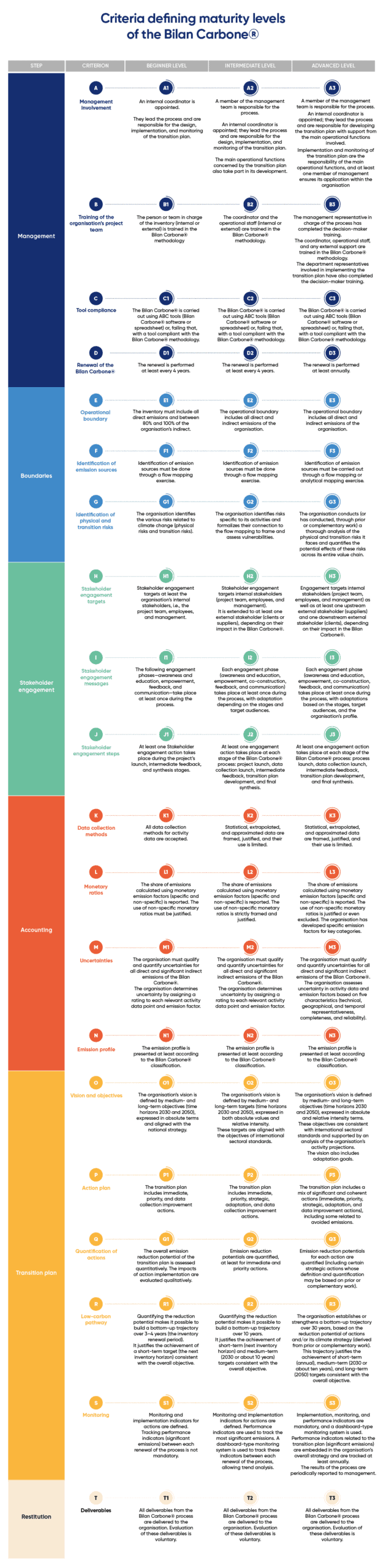
Comparison of the criteria of the maturity levels for continuous improvement of the Bilan Carbone®
The table below aims to provide an overview of the requirements for each of the three maturity levels. This table is not exhaustive, and remains generic, each point being detailed subsequently in the method via an adapted sub-section.
The use of the term Bilan Carbone® of Beginner, Intermediate and Advanced level in the organisation's communication is conditional on compliance with all the criteria of that level. However, it is possible for the organisation to highlight points on which it has gone further than what is required for its level, notably via the evaluation of its Bilan Carbone®.

🌐 English version of this image.
Do you have a comprehension question? Consult the FAQ. The method is living and therefore likely to evolve (clarifications, additions): find the track of changes here.
Last updated